5 August 2026, DCpedia, Marco Verzijl
Article: A sustainable data center does not start with a promise, but with verifiable evidence (machine translated from Dutch) The rapid growth of artificial intelligence makes data centers an increasingly important part of our economy and society, writes Marco Verzijl in a response to the article "How To Investigate Data Centers' Impacts". Virtually every digital service, from electronic health records and financial transactions to cloud software and generative AI, relies on physical IT infrastructure. Behind every digital application are servers, storage devices, network components, cooling systems and energy supplies.
22 July 2026, DCpedia, Marco Verzijl
Article: From intelligence ambition to demonstrable value: the data center debate needs a yardstick (machine translated from Dutch) The Dutch data center debate has been caught between two extremes for years. On the one hand, data centers symbolize high electricity consumption, grid congestion, space consumption and water consumption. On the other hand, they are presented as indispensable infrastructure for our digital economy.
6 July 2026, DCpedia, Marco Verzijl
Article: No sustainable AI without measurable evidence (machine translated from Dutch) AI is often presented as something abstract. As software. Like intelligence in the cloud. But the reality is physical. AI runs on data centers, GPUs, power grids, cooling, water, raw materials, chips, cables, buildings and ultimately waste streams. The "cloud" is not a cloud, but infrastructure. And infrastructure has a footprint.
19 June 2026, DCpedia, Marco Verzijl
Article: The government must set an example: data centers belong at the heart of the energy transition (machine translated from Dutch) The discussion about data centers is still too often conducted as if it were about separate buildings that use a lot of power. That is too limited. Data centers are not isolated boxes on the edge of a business park. They are part of a much larger chain: digital infrastructure, electricity grids, heat supply, water use, hardware production, raw materials, software efficiency, spatial planning and public accountability.
3 June 2026, DCpedia, Marco Verzijl
Article: Transparency is not a threat to the data center industry, but a prerequisite for legitimacy (machine translated from Dutch) The research of Investigate Europe exposes a painful reality: at a time when Europe wanted to gain more insight into the environmental impact of data centers, pressure from the sector actually took a step towards secrecy. Microsoft and DigitalEurope are said to have succeeded in getting a confidentiality provision in the European rules, which keeps data on the environmental impact of individual data centers out of public view. Lawyers even warn that this broad secrecy could be at odds with European transparency rules and the Aarhus Convention.
1 June 2026, DCpedia, Marco Verzijl
Article: From power to heat: why the data center is the new light bulb (machine translated from Dutch) A data center does not convert electricity into "power". It converts electricity into digital services: storage, computing power, transactions, AI models, video, cloud software and communication. But physically, almost all the electricity that a data center uses eventually ends up as heat. This applies to servers, network equipment, storage, power supplies, UPS systems, fans, pumps and cooling. A small part leaves the building temporarily as an electromagnetic signal, light or sound, but that too eventually ends up almost entirely as heat in the environment.
30 April, DCpedia, Marco Verzijl
Article: Data centers need space, but above all trust The question of how much space data centers in the Netherlands can have is more topical than ever. In a recent article in Het Financieele Dagblad (free to read, in Dutch), DDA director Stijn Grove and climate activist and scientist Guus Dix discuss this with each other. At first glance, they represent two extremes in the debate. Grove emphasizes the importance of data centers for the economy, digital infrastructure and geopolitical resilience. Dix warns of unbridled growth, extra energy consumption and the climate impact of a sector that, according to him, is too driven by expansion. Yet they touch each other on one essential point: the Netherlands lacks a clear vision on digital infrastructure.
28 April 2026, DCpedia, Marco Verzijl
Article: The EED reporting obligation: what does it really deliver? (machine translated from Dutch) Since 2024, the European Energy Efficiency Directive (EED) has required data centers above 500 kW to report annually on energy consumption, water use, PUE and residual heat utilization. The first results are disappointing: only 36% of European data centers reported, data quality is variable and crucial metrics such as IT utilization, GPU idle consumption and water consumption per AI run are completely missing. Enforcement is actually non-existent.
22 April 2026, DCpedia, Marco Verzijl
Article: Transparency is not a threat to the data center industry, but a prerequisite for legitimacy Investigate Europe's research exposes a painful reality: at the moment that Europe wanted to gain more insight into the environmental impact of data centers, a step towards secrecy was taken under pressure from the sector. Microsoft and DigitalEurope are said to have succeeded in getting a confidentiality provision in the European rules, which keeps data on the environmental impact of individual data centers out of public view. Lawyers even warn that this broad secrecy could be at odds with European transparency rules and the Aarhus Convention.
23 March 2026, DCpedia, Marco Verzijl
Article: PUE in data centers: useful indicator, but only valuable in the right context (machine translated from Dutch) Power Usage Effectiveness (PUE) is without a doubt the best-known efficiency metric in the data center industry. The simplicity of the metric has ensured that PUE is widely applied, cited and even used as a marketing tool. At the same time, that same simplicity is also the biggest pitfall. If you use PUE separately, without context or additional metrics, you can come to the wrong conclusions. In the worst case, incentives are even created that are at odds with actual energy savings.
19 March 2026, DCpedia, Marco Verzijl
Article: System Efficiency in Data Centers: Why Optimization Without Coherence Structurally Fails (machine translated from Dutch) Data centers are becoming more and more efficient per component, but increasingly heavy as a system. This article shows why fragmentation between IT, energy, cooling, and compliance leads to structural inefficiencies — and why system efficiencyis an administrative, not a technical, task.
13 March 2026, DCpedia, Marco Verzijl
Article: AI, GPUs, and the systemic energy blindness of digital infrastructure (machine translated from Dutch) AI requires not only computing power, but also energy consumption, grid load and social pressure. Yet many data centers lack fundamental insight into the energy effectiveness of GPU environments. This article argues that AI energy blindness is not a temporary measurement problem, but a systemic risk that requires new metrics, standardization, and governance responsibility.
12 March 2026, DCpedia, Marco Verzijl
Article: From measurement to accountability: why CSRD without operational IT metrics is structurally inadequate (machine translated from Dutch) Since the announcement of CSRD, an industry has emerged around reporting tooling, ESG dashboards and assurance processes. In many organizations, the reflex is the same: "what data do we need to provide?" instead of "what system behavior do we need to understand?"
26 January 2026, DCpedia, Marco Verzijl
Article: Transparency about energy and water: why the data center sector has been on the brakes for ten years – and why it is no longer sustainable (Machine translated from Dutch) With the growth of cloud and AI, the data center has definitively become a public infrastructure issue. Not only in terms of space and grid capacity, but especially in terms of energy and water impact. The reflex of the sector in the Netherlands over the past ten years has often been predictable: first put things into perspective with macro-statistics, then negotiate definitions and measurement methods, and only report as a last resort — when legislation is inevitable . The question is: why is that, what role do industry associations NLdigital and the Dutch Data Center Association (DDA) play, and to what extent do large (mostly American) players steer this behavior?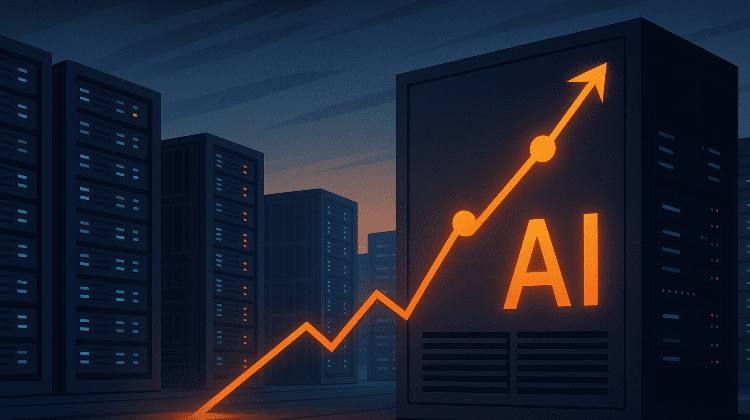
18 November 2025, DCpedia, Marco Verzijl
Article: The Future Energy Challenge of AI in Data Centers (machine translated from Dutch) We are on the verge of a new revolution in the digital world: the exponential growth of AI and the associated pressure on global data centers. Whereas until recently we were concerned about the energy requirements of traditional servers, we are now facing a bigger challenge: the energy hunger of AI models. The amount of energy consumed by data centers worldwide is increasing at a rapid pace – driven by AI.
9 October 2025, DCpedia, Marco Verzijl
Article: AI and the Invisible Energy Flow: Why Transparency and Equal Metrics Are Becoming Critical The discussion about the energy consumption of artificial intelligence (AI) in data centers is no longer academic. While the world is fascinated by the possibilities of generative AI, electricity demand is quietly growing explosively. The reality is that today's digital progress is directly translated into a physical energy demand that puts pressure on existing infrastructures.
15 September 2025, DCpedia, Marco Verzijl
Article: The Future Energy Challenge of AI in Data Centers (machine translated from Dutch) We are on the verge of a new revolution in the digital world: the exponential growth of AI and the associated pressure on global data centers. Whereas until recently we were concerned about the energy requirements of traditional servers, we are now facing a bigger challenge: the energy hunger of AI models. The amount of energy consumed by data centers worldwide is increasing at a rapid pace – driven by AI.
3 April 2025, DCpedia, Marco Verzijl
Article: From insight to action: concrete solutions for energy efficiency in IT (machine translated from Dutch) Awareness of energy consumption in IT is growing. The challenges are clear: AI and high-performance computing (HPC) are guzzling energy, data centers are getting bigger, and sustainability is becoming a critical factor for both cost savings and regulation. But how do we translate this awareness into actual action? In this follow-up article, we will dive deeper into concrete solutions to improve energy efficiency in IT.
11 march 2025, DCpedia, Marco Verzijl
Article: Just Do IT: getting a grip on energy efficiency in the IT landscape In the world of information technology, it's all about speed, computing power, and innovation. But as AI and high-performance computing process ever-increasing amounts of data, so do data centers' energy needs. The challenge? Doing more with less. And that starts with insight. Nike's slogan, "Just Do It," is a powerful call to action in this context: take proactive steps to improve energy efficiency.
2016 AUGUST, DATACENTERWORKS, BOB SEEMANN
Article: Terug naar N+1 met geld toe
N + 1 describes the degree of redundancy. This refers, for example, to the multiple implementation of energy systems and energy supplies in a data center. The ”N” stands for the peak capacity that must be available for day-to-day operations. The figure after the plus sign relates to the number of times that this peak capacity (by means of additional and independently operating installations and power supplies) is additionally available. At N + 1 we always have access to double …
2019 February, DataCenterWorks, Mees Lodder
Article: Druk zijn met niets doen, only available in Dutch.
Last time I explained why I was so shocked by the ”thermodynamic” efficiency of IT systems. I got to less than 0.1% and the incandescent light just discontinued had 10%.
I also met Harry, an IT specialist, and he could tell me a lot more about it. I have now done that. I’ll keep calling him Harry for convenience. It turned out that he already ”knew” me from KyotoCooling, because he had completely analyzed that for a customer. The conversation went by itself and in short: I think I have found my IT ”soul mate”.
My story to you should therefore also be seen as our story…..
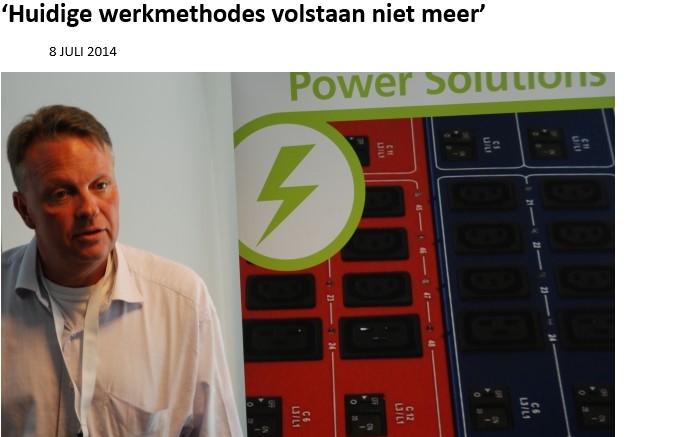
2014 JULY, DATACENTERWORKS, MEES LODDER
Article: Huidige werkmethodes volstaan niet meer , only available in Dutch
Raritan recently organized an afternoon about trends in the data center in collaboration with Electronics & Telematics and Dupaco. About twenty-five participants discussed topics such as energy consumption, capacity and PUE, the benefits of physical separation, on-site power generation for data centers and the business side of DCIM. Mees Lodder presented physicall separation
2017 FEBRUARY, DATACENTERWORKS, MEES LODDER
Article: DC in modules taart in stukken , only in Dutch available.
Why this attention to modular DC now? Why do the providers think there is a need for this today and not 10 years ago? What are the reasons for going modular today? I have a few for you: high start-up investment from each DC, DC customers only sign when the new DC is ready, the banks are much more critical to \\’borrow\\’, construction time of a DC of 2 years is too long for IT customers, new DC technology is desired by the customer …
2017 MARCH, DATACENTERWORKS, MEES LODDER
Article: DC in modules taart in stukken deel 2
Last time I hopefully made it clear to you, but especially to myself, why the data center is attractive in modules and for whom.
Lowering the initial investment is the main reason, with the aim of improving the ”bottom” line of the DC. It seems to me that building a DC today, without fixed customer contracts, is financially irresponsible….
2017 JULY, DATACENTERWORKS, MEES LODDER
Article: I will follow you deel 1, only available in Dutch
I haven’t done a DCIM project myself yet. Those times when I was asked to do so, I immediately ”counteracted”. The question was always: Martin, I want to have DCIM. Motivation? Because everyone else has it too …
It immediately goes ”wrong” was my thought. DCIM ”need” … I will follow you.
Behhh, the sheep bleated …
2017 SEPTEMBER, DATACENTERWORKS, MEES LODDER
Article: I will follow you deel 2, only available in Dutch
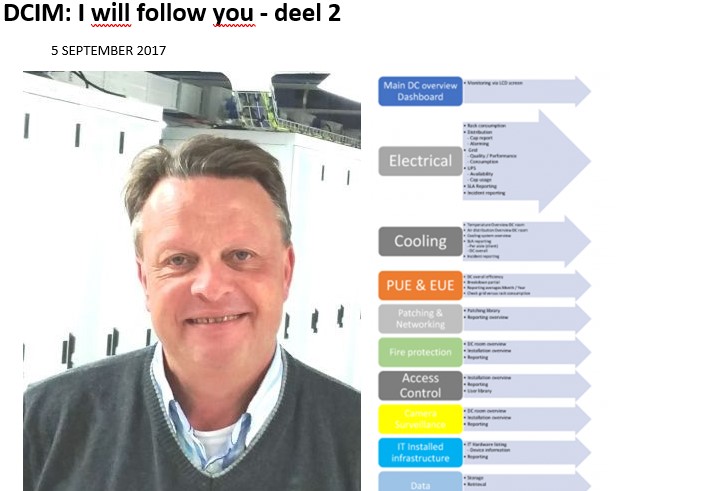
As promised last time, here is my help with making a DCIM plan. On the right is the list of all DC systems, but maybe you have or know more!
If you want to integrate all these systems and you want to, because that is DCIM, then make your choices from an overview and draw up a plan. Record your wishes and requirements for each sub-area, etc. That is your point B. Fine. Well done.
But now where, in my opinion, almost everyone ”chokes”. Where are you now? Yes, in A and far from B! ….
2015 MAY, DATACENTERWORKS, MEES LODDER
Article: PUE DC rijdt uw dc ook 1 op 7
1 in 7?
Recently I went through the report from the Municipality about all data centers in Greater Amsterdam. They reported in 2013 that the average PUE of DCs in its municipality is 1.8. Furthermore, the municipality believes that a PUE of 1.4 for existing DCs is the \”consumption\” of DCs \”should\” be …
2018, December, DataCenterWorks, Mees Lodder
Article: Schrikken van je eigen verhaal, only available in Dutch.
In April of this year I was the last to speak at the UPS Day organized by DatacenterWorks. I liked to speak last. My predecessors have already told all about UPSs, so that I can choose my subjects myself. As long as there is ”a hint of UPS” in it, say …
2019 September, DataCenterWorks, Mees Lodder
Article: hoe meten we de DIC, only available in Dutch.
The DIC was introduced in the previous edition of CloudWorks and DatacenterWorks. The purpose of this measurement is to provide insight into how efficiently IT handles the \”power\” in the data center. While it is currently unclear what the efficiency is, it is estimated that 60 to 80% of all energy is consumed to the data centers without any real IT performance being delivered. In short, doing nothing in IT takes a lot of energy….
2019 May, DataCenterWorks, Mees Lodder
Article: nieuw instrument einde maken aan energieverspilling, only available in Dutch.
The energy consumption of data centers will increase rapidly in the coming years – with the increase in data use – especially after the introduction of the 5G network. Fortunately, there is still a lot of room for data centers to save energy, because they use a lot of energy in an idle state. There are measures to be taken for this, but data centers prefer not to take them because they are judged on their performance. A new instrument measures the so-called Datacenter Idle Coefficient (DIC). This makes energy waste measurable and visible….
2015 APRIL, DATACENTERWORKS, MEES LODDER
Article: Geen PUE maar LUI
(Not P.U.E. but L.U.I., Lui is a Dutch word, translated in english it’s Lazy)
Nowadays it is not possible to talk about a data center or the word large energy consumer is used. You are power guzzlers, often accusingly. We are not, but we do consume a lot. Can I do something about the fact that many computers use a lot of power?
2014 AUGUST, DATACENTERWORKS, MEES LODDER
Article: DCW14 aug ML fysieke scheiding; moeder van inefficiency only available in Dutch
Physical separation is the standard in every data center. However, due to incomplete separation, your PUE is at least 0.2 higher than necessary and HotSpot’s are still there. We will explain how and why.
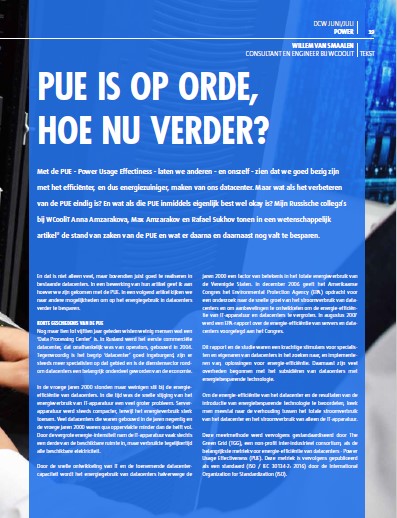
2020 May, DataCenterWorks, Willem van Smaalen
Article: Pue op orde hoe verder only available in Dutch
With the PUE (Power Usage Effectiness) we show that we are doing well
making our data center more efficient, and therefore more energy-efficient. But what if improving the PUE is finite? And what if that PUE is actually quite okay now? The Russian colleagues from WCooliT show in a scientific article the state of affairs of the PUE and what can be saved after that and in addition.

2021 January, LEAP, Marco Verzijl, Max Amzarakov
Report: LEAP Track 1 ’Powermanagement’ Pilot analysis
The first track of LEAP was sparked by the observation that the overall electric power draw of datacenters is almost constant. This is in sharp contrast to the know variations in demand for ICT services. As a result, an investigation has been started to try to find the reason for this stable power draw as well as to try to lower the overall energy use of datacenters by introducing a more workload connected power draw. The LEAP core team mobilized a group of companies willing to take part in pilots to provide data on their current ICT environment and willing to change certain settings to measure the effect on energy use of the servers being monitored.
The following document describes the results obtained in the LEAP Track 1 ‘Power management’ Pilot analysis. This final report contains additional measurements collected to increase the overall reliability of the conclusions that are drawn. The analysis contains observations, conclusions and recommendations.
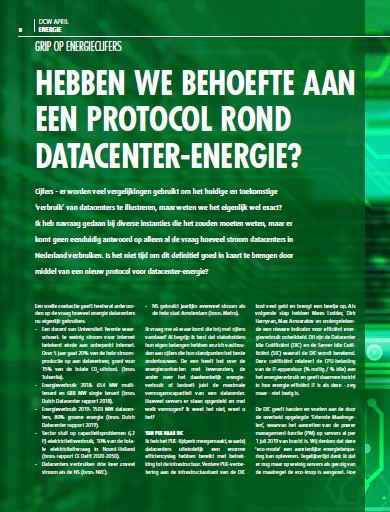
2020 April, DataCenterWorks, Marco Verzijl
Article: Behoefte aan nieuw protocol rond datacenter energie only available in Dutch
Numbers – many equations are used to measure the present and future “consumption” of data centers in the Netherlands. Isn’t it time to definitively map this out by means of a new protocol for data center energy?
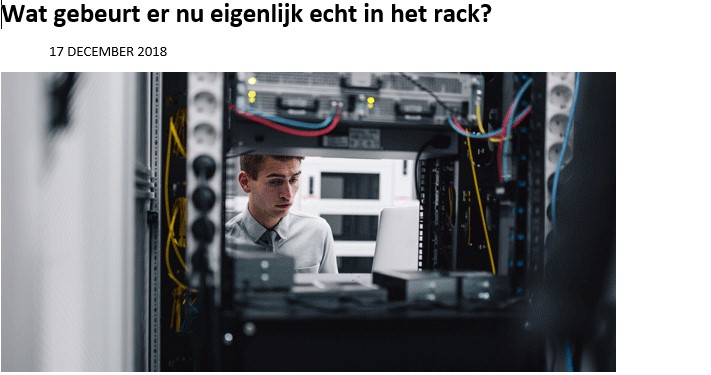
2018 December, DataCenterWorks, Mees Lodder
Article: Wat gebeurt er nu echt in het rack
Hereby the closing part of our series of ”stories” about IT hardware with its heat read cooling. Of course not the last part, but we are empty.
We have shared everything we ”get” today. Below the topics we are currently working on. It will take a while before we have gained more knowledge, hence this break.
But first something else. We recently visited the IT Room Infra fair in Den Bosch. We were allowed to set up our demonstration there. All day long we loaded the server…..
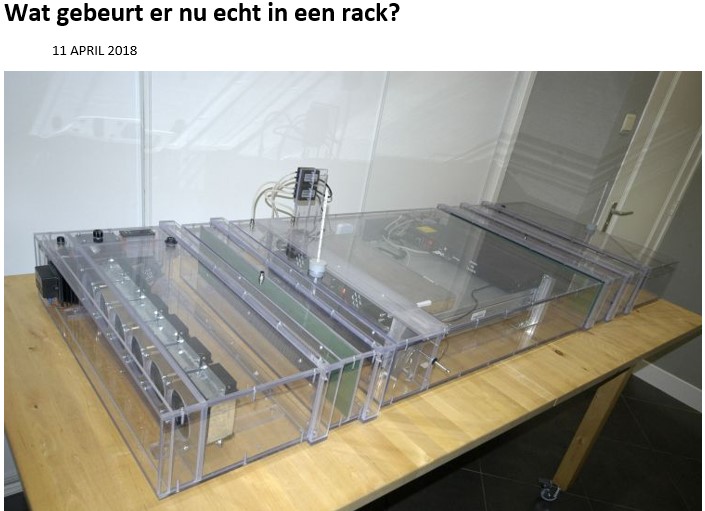
2018 April, DataCenterWorks, Mees Lodder, Willem van Smaalen
Article: Wat gebeurt in rack deel 1, only available in Dutch.
In 2005, at Getronics, where I worked at the time, we were one of the first with a cold hallway. That was the start of optimizing the cooling of the IT equipment. The reason was that we had a problem with an ever-increasing temperature around the front of the racks, the cold inlet side. The IT load per rack was still low at the time, but developed rapidly due to the introduction of the 1U servers in particular. These \”pizza boxes\”, many in a rack, delivered loads of up to 6 kilowatts per rack ……
2018, June, DataCenterWorks, Mees Lodder, Willem van Smaalen
Article: Wat gebeurt in rack deel 2, only available in Dutch.
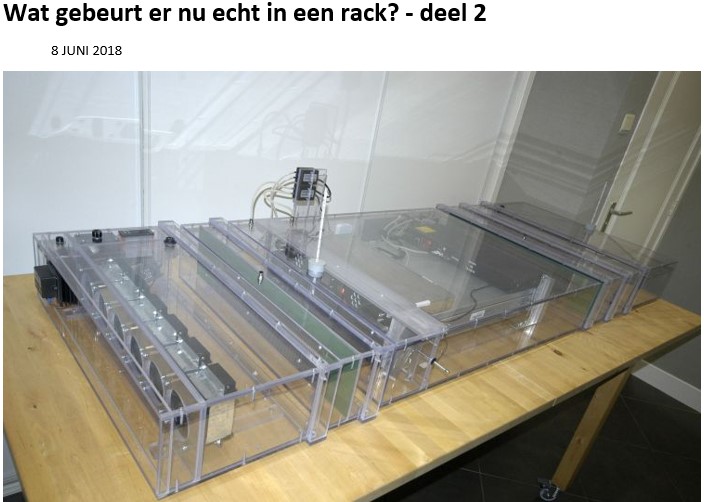
In the previous issue of DatacenterWorks, we noted that in a rack, air flows \”naturally\” through openings in the physical separation. The fans of the IT equipment blow air from front to back in the cabinet and the air \”recirculates\” from back to front through the resistance of the doors. In this issue we look at its temperature effects.
In this series of articles we show you….
2018 September, DataCenterWorks, Mees Lodder, Willem van Smaalen.
Article: Wat gebeurt in rack deel 3, only available in Dutch.
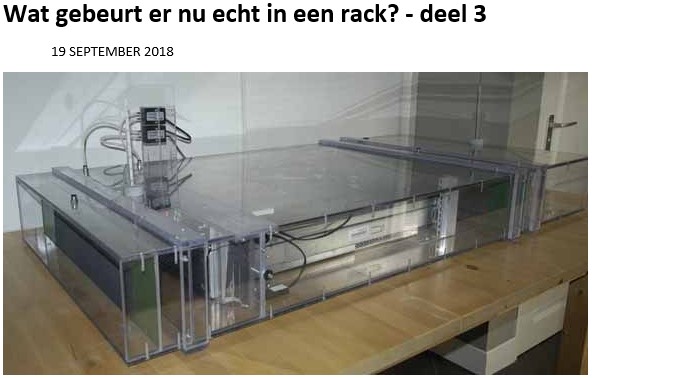
In the previous article we found that warm air ”naturally” partially recirculates in a rack and that this can increase the inlet temperature of the equipment by up to a few degrees. In addition, we have seen that construction and installation of the equipment can also cause similar partial recirculation or full recirculation, where equipment runs completely in the warm air and can endure up to 12 ° C higher inlet temperature. In this article, we look at what happens if we provide more or less air than the equipment in the rack requires….
2018 October, DataCenterWorks, Mees Lodder,Willem van Smaalen.
Article: Wat gebeurt in rack deel 4, only avalable in Dutch.
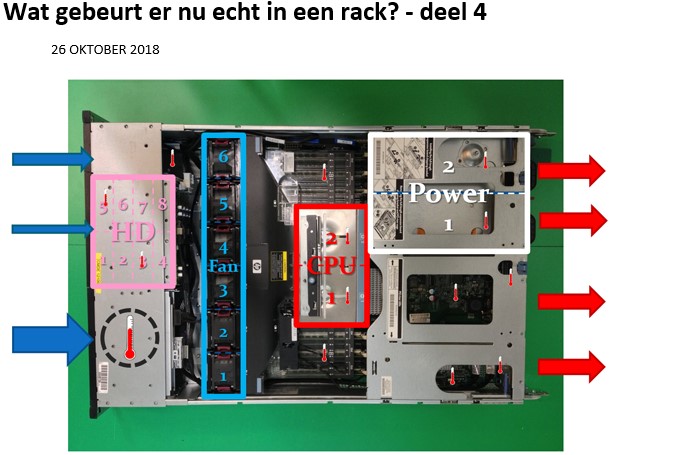
In the previous installments we looked at what is happening in the rack around the server. That is logical, after all, in our data centers we focus all our attention on offering a ”pleasant working environment” to the housed IT equipment. In this episode we look at whether IT equipment itself also has an ”opinion” about ”how good it feels” and how we can use it safely…
2018 November, DataCenterWorks, Mees Lodder, Willem Van Smaalen
Article: Wat gebeurt in rack deel 5, only available in Dutch.
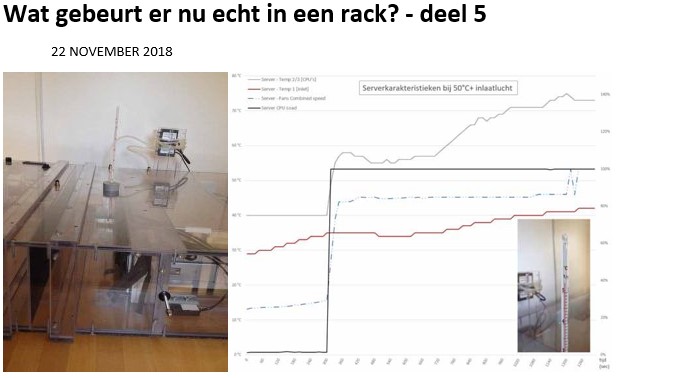
In the previous installments we looked at what is happening in the rack around the server. This is logical, after all, in our data centers we focus all our attention on providing a ”pleasant working environment” in the form of cool air to IT equipment. We have seen that close to the server in the rack, the flow can be accurately measured with equipment such as the AirLull, based on which….